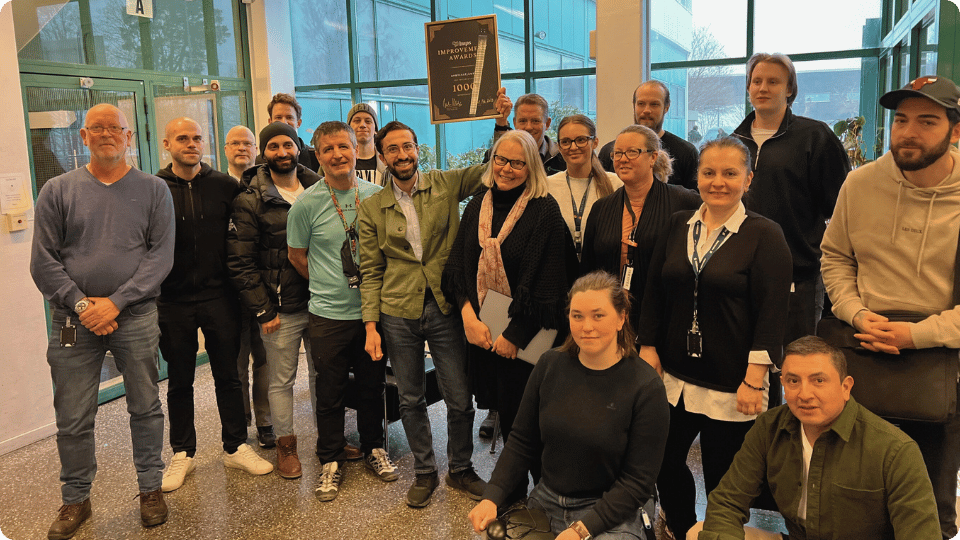



Bauer Media Outdoor Sweden cut the time it takes to create a client quote from often more than a working day to under two hours. The change did not come from people working faster. It came from better handovers between sales and booking, and from one cross-functional team, with the executive team inside it, that owned the whole flow.
To get there, Bauer moved from working function by function to working as one cross-functional team around the client's request. Members of the executive team sat in the change team themselves. And Bauer used the Hups methodology on its own real problems, its own orders and its own data, not on textbook examples.
About Bauer Media Outdoor Sweden
|
Fact |
Details |
|---|---|
|
Industry |
Media |
|
Markets |
Sweden |
|
Process in focus |
The quotation and booking process, from client request to signed booking |
|
Change team |
14 people from across the organization, including members of the executive team |
|
Hups' role |
Online training, a flow efficiency workshop and support through the Hups transformation model |
|
Case time frame |
2023–2025 |
The situation: quotes took too long
Bauer Media Outdoor took too long to create quotes for its clients. A quote often took more than one working day, even for a standard request.
Bauer was organized in a traditional way, by function. It used a mix of older and newer systems, because digitalization had added new software where each part of the organization needed it. Nobody owned the whole flow from the client's request to the signed booking.
The real problem: the work was mostly handovers
The team first assumed the problem was speed. The data showed something else. Most of the time, nothing happened to the client's request. It waited between people, between departments and between systems because handovers were incomplete and information was missing.
One order, followed for seven days
The team analyzed the flow efficiency of one real order: the share of its total journey spent on work that added value for the client. They followed it step by step, from the client's first email to the signed booking.
What they found:
- The order took seven days from request to booking.
- The work passed through 51 handovers between people, departments and systems such as email, Power BI, the quotation system and Jira.
- Value-added work was about two hours and fifty minutes. That is 3.7% of the lead time. The rest was waiting.
- The client rejected the first quote. Two extra rounds of changes followed. If the first quote had been right, those two phases would not have been needed.
"It became clear to us that we needed to get it right the first time. To do that, we brought together a cross-functional team with better access to data to solve the task at hand."
Victor Ödmark
Chief Business & Operations Officer
Bauer Media Outdoor Sweden

200 orders confirmed the pattern
One order could be a one-off. So the team pulled data on the last 200 cases into Excel and looked at team, accuracy, product, deadline and geography.
- The average throughput time was well over two working days. The first order was normal, not an exception.
- About 50% of handovers from sales to booking were marked as needing more information.
- When booking needed more information, 70% of requests took more than one day.
- When the information was complete, 70% of requests took less than four hours.
This was the insight. Going from seven days to two hours looked impossible. Going from four hours to two hours looked possible. The difference was the quality of the handover from sales to booking.
Why it looked like this
Bauer's structure was not unusual. As organizations grow, they often divide work into functions, each with its own targets. People work hard to meet those targets, but good results in individual functions do not always translate into a good result for the client. Without a shared view of the whole flow, requests can wait between teams.
What Bauer did
Bauer organized its work around the client's request. Three choices made the difference.
1. The team was organized across functions
The CEO gave the assignment to Victor Ödmark, the Chief Business & Operations Officer. He had a clear mandate and the freedom to do it his way. He also knew the team was very different: some people came straight from school, others had worked at Bauer for many years.
Victor did not build a project team inside operations. He built a cross-functional team that covered the whole flow from sales to booking. The question changed from "Is my function doing well?" to "How fast and how well do we serve the client?"
2. The executive team was part of the change team
Victor first gathered members of the management team. He then asked each of them to add the key stakeholders they thought were needed. The executive team did not sponsor the change from a distance. They sat in the team, did the same training and analyzed the same order as everyone else.
This mattered for two reasons. Leaders saw the 51 handovers with their own eyes, so the problem was not a report from someone else. And when the team needed to change targets and priorities across functions, the people with the mandate to do it were already in the room.
"By building knowledge, developing a shared understanding of the flow, and embedding that understanding throughout the organization, we created momentum and gave everyone a clear picture of where we were heading."
Victor Ödmark
Chief Business & Operations Officer
Bauer Media Outdoor Sweden
3. Hups' methodology was applied to Bauer's real problems
Hups supported Bauer with online training, a flow efficiency workshop and its transformation model. Bauer's team applied the approach to its own orders and data, identified the problems and developed improvements together.
- Shared training first. All 14 people completed an online training program on flow, focus, cross-functional collaboration and continuous improvement. Victor set one rule: 100% completion before the first workshop. Everyone needed a shared understanding of how to analyze the flow.
- Analysis of a real order. In the workshop, the team mapped order 110457, not a made-up example. They found the problems themselves.
- A shared target. The CEO asked what would happen if the target was a lead time below two hours. The team accepted it, with one condition: the same volume of client requests. A shorter lead time should not come from doing less work.
- Root causes and the most important resource. The team did a root cause analysis for each problem. They then looked at which resources the work needed: staff, information, material and systems. Information had the biggest gap between the current and desired states.
- A simple first step. Before a salesperson handed work to booking in Jira, the system prompted them to consider the handover: "Am I handing over the baton in the best possible way? Will the next person have everything they need to get started?"
- Everyone involved in the improvement work. The team used an online improvement board, with an expectation that every member would contribute.
"Doing things right the first time and maintaining momentum gave us speed. Working on fewer tasks at the same time meant we could complete each one faster."
Victor Ödmark
Chief Business & Operations Officer
Bauer Media Outdoor Sweden
Smaller handover batches
Bauer also reduced the number of orders passed on together, moving toward handling orders one at a time. The team kept all relevant information in one place so that nothing was lost during handovers.
Four capabilities the team built
The work focused on four capabilities:
- Performance management: one target for the whole flow, lead time below two hours, visible on boards.
- Flow management: progress tracked for each client request through the phases.
- Resource management: focus on the availability of the most important resource, correct information, not on how busy people were.
- Improvement management: a shared board where everyone identifies problems and contributes to improvements.
Results: better handovers, smaller batches, faster quotes
Bauer improved its handovers and reduced the number of orders passed on together. As the team learned to work in the new way, internal lead time dropped to well below the two-hour target within a few months.
|
Measure |
Before |
After |
|---|---|---|
|
Internal lead time per quote request |
Often more than one working day (8 hours) |
Well below 2 hours |
|
Number of client requests |
6,500 requests per year |
5,700 requests per year |
|
Average throughput time, request to booking (last 200 cases) |
6.4 days |
1.7 hours |
Another indirect and important effect is that the team also reduced the number of credit notes issued because of previous incorrect information on customer orders.

What other leaders can learn from Bauer
The biggest lesson: if your teams are busy but clients still wait, look at the handovers before you look at the people. At Bauer, the value-added work was less than three hours. The rest of the seven days was waiting, often for information that should have been there from the start.
For your organization, the practical question is whether each handover gives the next person what they need to continue the work without delay.
What made Bauer's change work:
- Leaders were inside the change, not above it. The executive team saw the problem themselves and could change cross-functional priorities on the spot.
- The method met real work. The team analyzed its own orders and its own data. People believed the findings because they found them.
- Everyone took part. 100% completion of the training and 100% involvement in improvement work.
- The team built its own boards and targets. By analyzing its own work, it identified correct information as the resource that needed the most attention.
At Hups, we're proud to have supported Bauer in building the capabilities to keep improving together. It's what our work is all about: developing self-improving organizations.
Questions you can ask in your own organization
- Can anyone describe what happens to a client request before and after their own part of the work?
- How many handovers does one request go through, and how many of them need to be corrected?
- Is your executive team analyzing the flow with the team, or waiting for a report?
- What is the one resource your flow most often waits for?
Run improvement work yourself
Are you interested and curious about Hups? Book a demo below to understand how we can help your organization understand and improve your flows