


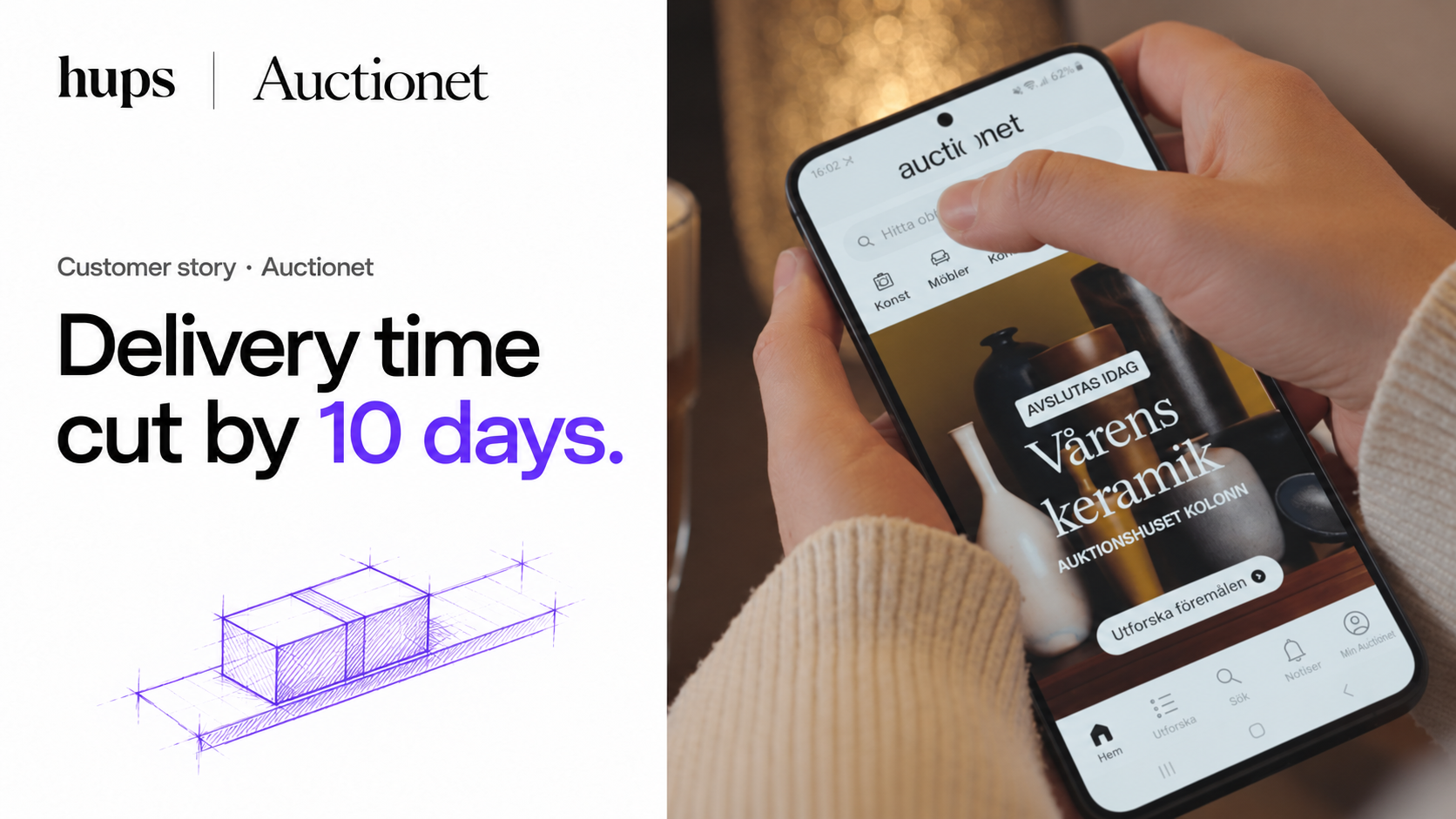
Watch Auctionet's COO and Logistics Manager explain how they cut delivery time from 17 to 7 days (3 min).
Auctionet, an online auction marketplace, cut delivery time to the end customer from 17 days to 7. The logistics centers did not get bigger and people did not work harder. Managers and employees mapped the full flow from item arrival to delivery, found where items waited, and removed those bottlenecks. Today the teams run their own improvement work.
About Auctionet
Industry: E-Commerce
Region: Europe
Headquarters: Stockholm, Sweden
Size: 100+ employees
Auctionet runs an online marketplace for auction houses. It works with 78 auction houses across Europe and has sold more than 3 million items, from antique furniture to fine art. Auctionet offers transport for every item it sells, wherever the buyer lives.
Auctionet launched in Sweden in 2011. The auction houses focus on valuing and selling. Auctionet takes care of logistics, customer service, marketing and finance. Today it runs three logistics centers in Sweden, one in the UK and one in Germany, plus a network of collection points across Europe.
The challenge: you cannot plan for items you have never seen
Most e-commerce warehouses know what they stock. Auctionet does not. Every item is unique, and items arrive from many auction houses, often at short notice.
"A major challenge for Auctionet, specifically within the logistics department, is that we can never be 100% sure what items will arrive on any given day, as we don't have items on a shelf where we have the exact dimensions or weights."
Houman Atashpour
Logistics Manager, Auctionet
Every item is also valuable and needs secure packaging. A chair or a painting cannot go into a standard box. This made the flow hard to plan. Sold items waited in the logistics centers before transport. Delivery took 17 days on average and was hard to predict for buyers.
The approach: the people who do the work mapped the flow
Auctionet asked Hups to help find where its flows lost time. Transport times were long, and nobody had a clear view of how well the service worked for the end customer.
Auctionet did not bring in consultants to redesign the process. Through Hups training programs and the Hups platform, managers and employees mapped the full flow together, from the day an item arrives to the day the buyer receives it. They marked where items waited and why.
"With help from our digital training programs and transformation platform, they were able to involve managers and employees to create a shared view of their delivery process and flows, and identify what the bottlenecks were."
Joacim Harrby
Chief Operating Officer, Hups
The improvement ideas came from the teams. Hups gave them a structure to test and follow up each change, with the end customer in focus.
The results: delivery time from 17 days to 7
Delivery time to the end customer fell from 17 days to 7. The faster flow also changed daily work in the logistics centers.
More space and less waiting in the logistics centers
When items move faster, they take less space. Staff find items more easily, and there is room for new arrivals.
"Items no longer sit around gathering dust waiting for further transport, which makes our logistics centers much more efficient."
Peder Slettengren
Chief Operating Officer, Auctionet
More motivated employees
A shared view of the flow made roles and daily tasks clearer. Auctionet reports that employees are more motivated, and that the company is moving closer to working like an e-commerce company.
Buyers order more transport
Faster delivery changed buyer behavior.
"Buyers are now more likely to order more transport from us since it's faster. It's therefore more fun to bid and order transport from Auctionet."
Peder Slettengren
Chief Operating Officer, Auctionet
Speed without lower quality
Faster delivery only counts if the item arrives in good condition. For Auctionet, quality on arrival is still the most important measure, not speed alone.
What other organizations can learn
- A full warehouse is a sign of slow flow, not high demand. Items that wait take space, hide other items and delay customers. Look at where work waits before you add capacity.
- The people who do the work should map the flow. Auctionet's managers and employees found the bottlenecks themselves. That is why the changes stuck.
- Build a habit, not a project. The goal is a team that keeps improving after the first result.
Next steps
Auctionet continues to work with Hups. The focus now is to build improvement capability in its teams, so they can find and fix the next bottleneck on their own.
Run improvement work yourself
Do your teams know where work waits in your flow? Book a demo to see how Hups helps teams map their flow and improve it themselves.