

Part 2 of 2 in a series on flow-oriented strategy execution. Read Part 1: Flow as your truth teller.
In the first part of this series, I described a meeting where a CEO and his leadership team discovered that out of eighteen active initiatives, only five had actually delivered anything that month. The room went quiet. Then someone asked the obvious next question: “So what do we do about it?”
This is the second part of that story. It is also the part where the leadership team had to confront something harder than the data itself - their own habits.
Confronting the Portfolio
The first move was the hardest. Carsten, the COO, sat down with each department head and went through every active initiative with one question: “If we stopped this tomorrow, what would actually happen?” For a surprising number, the honest answer was “not much.” Other initiatives were too important to stop but had been started before there was real capacity to finish them.
After three rounds of this conversation, the portfolio went from eighteen initiatives to six. Henrik, the CEO, was the most uncomfortable person in the room. “What if we miss something important by not pursuing it now?” he asked. Thomas, the CFO, pointed at the previous month’s numbers. “What if we keep missing what we already said was important?”
Six initiatives became their strategic agenda for the rest of the year. Each one got an owner. And each was captured on the Bowler Chart.
Making the Invisible Visible
The Bowler Chart, named after the scoring sheet that tracks every ball bowled and every run scored against it, is one of the simplest and most underused tools in strategic execution. On a single page, it shows:
- What an initiative is aiming to achieve (based on need)
- Whether progress is real
- Where things are slipping
- What the team is doing about it
The power of the Bowling Chart comes entirely from what it makes it impossible to hide, not from the template itself.
Here is what one of Henrik’s six initiatives, “Reduce new product time-to-market”, looked like six months in:
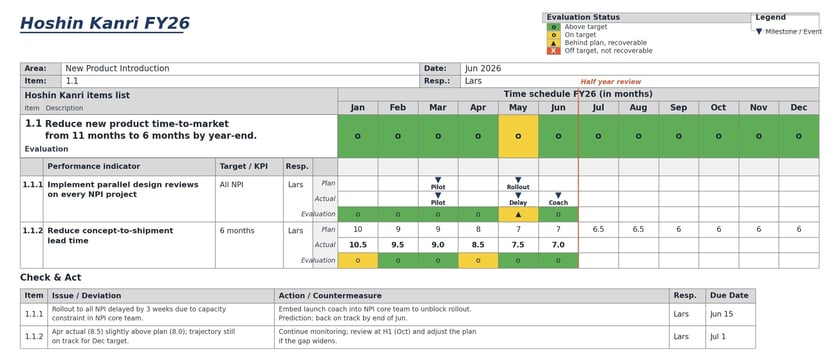
A Bowler Chart for one of Henrik’s six strategic initiatives, in a format often used by leadership teams. The single page captures outcome, plan vs. actual, evaluation, milestones, and the countermeasures that come out of each review.
On the left, the initiative and its sub-items. On the right, twelve months of progress, with three rows under each sub-item: Plan, Actual, and Evaluation. The evaluation row uses a traffic-light convention, but the light is set against the year-end target, not against whether this month hit its number or the plan. A green light in April does not mean “we hit April’s plan.” It means “even with what happened in April, we still believe we will hit December.”
Sub-item 1.1.1 tracks the rollout of parallel design reviews across new product introductions. The plan called for a pilot in March and a full rollout in May. The pilot ran on time. The rollout slipped by three weeks because the cross-functional core team was over capacity. The May evaluation turned yellow. Lars, the initiative owner, did not bury the deviation in a footnote, he brought a countermeasure to the next review: embed a launch coach into the core team to unblock the rollout, with a clear prediction of when it would be back on track. That countermeasure is recorded in the Check & Act table at the bottom.
Sub-item 1.1.2 tracks the underlying KPI: months from concept approval to first customer shipment, with a target of six months by year-end (down from eleven). The plan row shows the expected monthly trajectory. The actual row shows what is really happening. April’s actual (8.5) was slightly above plan (8.0), a yellow signal, but well within margin and on track for December.
That is the rhythm: visible deviation, fast response.
The Question That Changed Everything
In their old monthly reviews, the question on the table was always some version of “Are we following the plan?” Status updates answered it well enough - most things were green or yellow, and everything looked like it was moving.
After they introduced the Bowler Chart, the question changed to: “Will we still meet the year-end target?”
That single shift altered the entire dynamic of the room. Suddenly, monthly variance was less interesting than trajectory. Activity reports were less useful than outcome data. Owners stopped defending the plan and started defending the outcome.
The plan, in this new way of working, was treated as a hypothesis - a best current understanding of how to reach the target, ready to be updated the moment reality demanded it, not a contract or a fixed promise.
Four Habits That Had to Change
Putting up a Bowler Chart on the wall changes nothing on its own. What changed for Henrik’s team was the way they led around it. Four habits in particular had to shift and each one was uncomfortable for someone.
1. Treat plans as hypotheses, not promises.
For Henrik, this was the hardest. He came from a culture where committing to a plan was a measure of seriousness. Now he was being asked to treat plans as something the organization should constantly learn from and revise. The question he had to stop asking was “Why did you miss the plan?” The question he had to start asking was “What are we learning about the system?”
Ask yourself: when an initiative falls behind, does your team explain the plan, or find ways to adjust it?
2. Run deviation meetings, not status meetings.
Carsten’s monthly initiative reviews used to take ninety minutes and cover everything. The new reviews took forty-five minutes and covered only what had moved off track. If an initiative was green and there was nothing to discuss, it got a sentence. If it was yellow or red, the owner walked the team through the deviation and the proposed countermeasure. Time stopped being spent on what was working and started being spent on what was not. With this approach they also started to address the deviations as a team and with a cross-functional mindset.
This required courage. Once deviations become the centerpiece of the meeting, leaders can no longer hide behind optimistic narratives or activity metrics. The system starts revealing the truth.
3. Protect focus. Resist starting.
This was the discipline Henrik almost broke twice. Both times, a new opportunity emerged that “we really should pursue right away.” Both times, the team made him choose: which of the six initiatives are we going to stop? Both times, he chose to wait. Both times, the new opportunity could have absorbed the entire portfolio’s capacity and delivered very little.
Flow-oriented leadership rests on a simple discipline: starting creates activity, but only finishing creates value.
4. Use the Bowler Chart for dialogue, not control.
Mette, who led the transformation work, insisted on this from the beginning. The Bowler Chart, she warned, would only work if it stayed a shared learning system. The moment it became a top-down control mechanism, owners would start managing the chart instead of the outcome.
So they used it for dialogue. Leadership defined what had to be achieved. Teams defined how. Both sides continuously adjusted together. That back-and-forth - the Catchball process - is what builds ownership across the organization rather than mere compliance.
Six months later
By the end of the year, Henrik’s team had delivered four of the six initiatives. One had been replanned mid-year after the Bowler Chart made it clear that the original approach would not reach the target. One was still in flight but trending green.
By year-end, Henrik’s team had built something quieter and more durable than a dramatic turnaround: a steady rhythm of strategy that actually lands.
The room is no longer surprised by year-end numbers. The leadership team trusts what they are seeing, because what they are seeing is flow.
Where to go next
If you recognize the situation Henrik’s team found themselves in - too many active initiatives, too little that actually landed - the Bowler Chart is the most practical place to start. At Hups, we help leadership teams build this into the way they run strategy, from the first chart on the wall to a sustained review rhythm across the organization.
This blog post is a part in a series of articles and webinars. If you want to dive deeper:
Read Part 1 in the series: Flow as your truth teller.
Watch the webinar "When Everyone Is Busy but Strategy Isn’t Delivering"
Or:
Book a 30-minute conversation with Fredrik Fjellstedt